
Art-Science Residency
Shifting perspectives through art and neuroscience
Moving as One:
Exploring the Power of Cooperationtatic
What if we stop competing and treat differences as opportunities for collaboration? Inspired by the collaborative functioning of brain regions, this short work-in-progress animation explores how limitations become strengths and interdependencies enable cooperation.
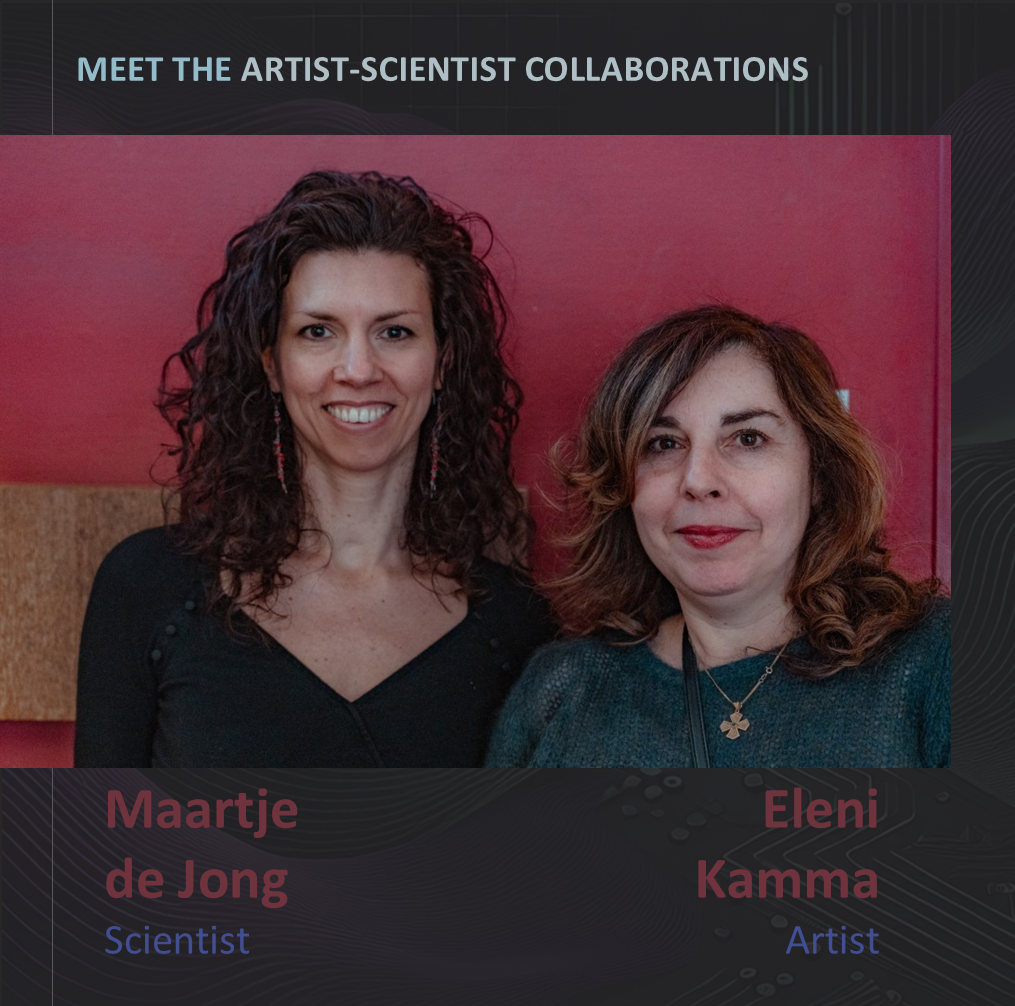
Eleni Kamma
Artist
Eleni is a visual artist, researcher, and educator living and working in Maastricht and Brussels. She holds a PhD from Leiden University Academy of Creative and Performing Arts and was a Fine Art Researcher at the Jan Van Eyck Academie. She is currently exploring costume-making as a procedural memory activity and how this contributes to the re-formation of memory and folkloric heritage.
Maartje de Jong
Scientist
Maartje is a scientist at the Netherlands Institute of Neuroscience. She is interested in how our brain makes sense of all the information it receives through our senses. Her researches want to know how our brain uses this information to create a meaningful image of the outside world. An image that serves our needs and goals and guides our behaviors.
What if we stop competing and instead see differences as opportunities for collaboration?
Neuroscientist Maartje de Jong and visual artist Eleni Kamma explore this concept, inspired by the collaborative functioning of brain regions. Together with animator Léo Ghysels they are developing a short animation, a work-in-progress. It serves as an allegory for systems of cooperation that emerge from interdependence.
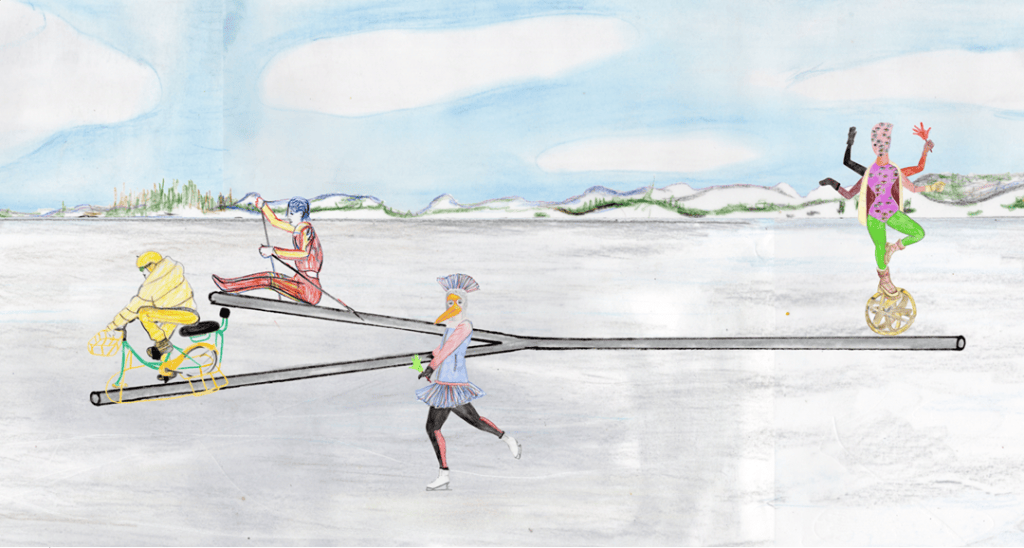
The animation shows a vehicle that moves in one direction through a system of interactions and interdependencies between four characters. Each character has essential skills needed to move the vehicle forward. At the same time, none of the characters can move the vehicle forward on their own.
A bird-like skater is the only character that can relocate. It has no ideas of its own, but its urge to relocate allows it to deliver messages from the coordinator to the biker and rower.
A dancer-like coordinator with many eyes stands at the rear of the vehicle and has overview over the scene. It can assess whether the biker and rower in the front need to move faster or slower for the vehicle to keep its straight course. Its only means of communication with the biker and rower is to give signs to skater.
At the front of the vehicle are a yellow biker and a red rower with an innate tendency to move specific body parts: the biker moves its legs and the rower moves its arms. They cannot relocate or perceive the coordinator, nor can they stop moving entirely. They can slow down (red sign) or speed up (green sign) depending on signs that the skater delivers.
Here, your limitations define your strengths.
Expo: NeuroNarratives
Art exhibition and symposium
2-4 October 2026
Waag Futurelab, Amsterdam
Free entrance

EXPERIENCE YOUR MIND

Got questions? Contact us.
neuronarrativesinfo@gmail.com
© NeuroNarratives 2025-2026. All rights reserved.

